
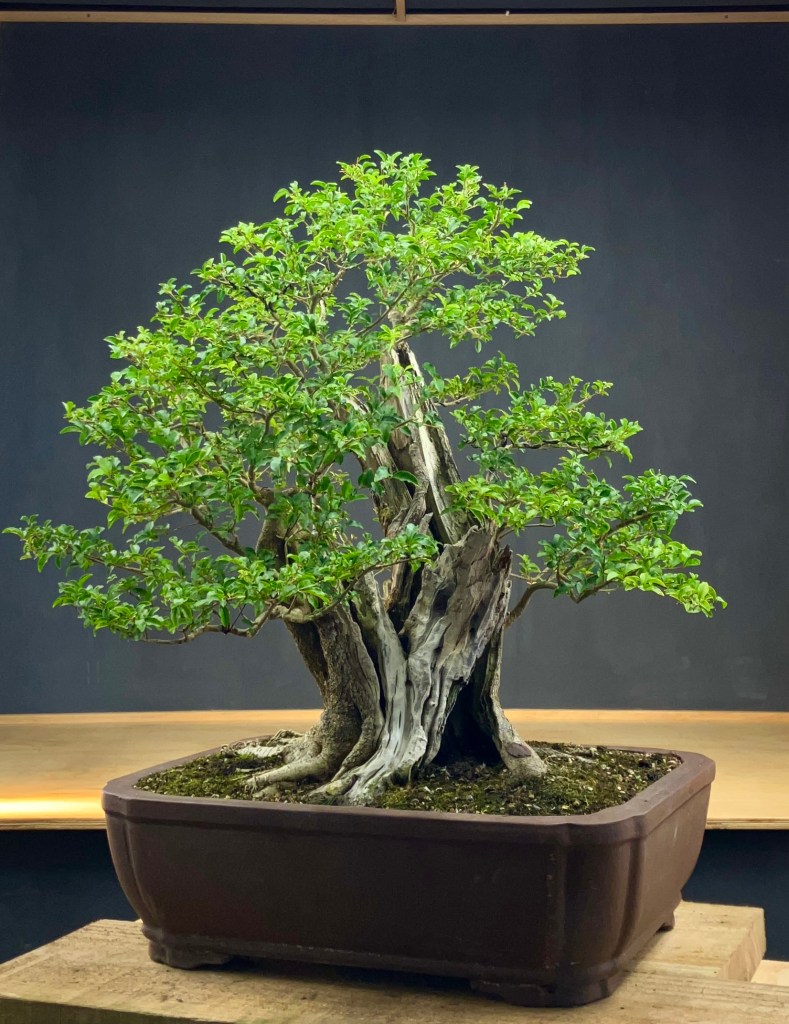
Precursor, I wrote this as an article for our local bonsai association a year or two ago and thought I would share it here…
Have you ever considered why we generally have our bonsai displayed on a bench or pedestal rather than just randomly on the ground in our gardens? Why we risk the randomness of mother nature or life in general of a bit more exposed site? Or why we don’t use the much-discussed health benefits of trees placed on the ground? That might seem like a straight forward and strange question to offer up for discussion, but stick with me for a bit longer.
Have you ever experimented by placing your bonsai on the floor and viewing it from a few feet away and then lifting it to the correct viewing height (approximately eye-level into the top third of the canopy) and viewing it? Yes, your obvious response should be that it looks 1000 times better! As to why? Well, that’s straight forward, however, I’m more intrigued with how it made you feel or lack thereof when seeing it on the floor. If like me, your response should have been quite dramatic! Every evoked emotion for the tree when viewed at the correct height is not present. Strange, it’s still the same tree, isn’t it?
One could easily draw a parallel to having a beautiful painting leaning against the base of a wall in your home rather than hung up on the wall, displayed for all to see and enjoy. It may be a great painting for various reasons but to anyone walking past it, its beauty will mostly likely go unnoticed and even if it does grab their attention, would they understand the underlining meaning or would you have to explain it to them? So, where am I going with this?
When it comes to Bonsai exhibitions, we display our tree’s static and what I mean by that, is that the location where we place our tree (on that table or stand), is the exact location that the viewer is going to view it. So, if the tree is displayed too low, the viewing angle is down onto the canopy and you don’t see the branching, trunk or any other special features of the tree. If for example you are the owner of a beautiful deciduous tree with fantastic ramification, you are going to want the viewer to see and more importantly enjoy this. The same goes for that special feature of your tree that evokes an important feeling, which is a major factor in the ultimate display of the tree, but is consequently hidden from the viewer at the incorrect display height.
Now, I know what you are thinking, no, we can’t expect the viewer or judge to bend down/ squint with one eye open/ lean slightly to the left to find the beauty of the tree that is there but not seen or felt at first glance. More importantly, and leading into my closing thoughts, we cannot underestimate the viewers first sight, that immediate emotion felt and how this effects the viewers overall response to the display.
To tie this in with the title (got there eventually), we know that the human mind is extremely complicated and our emotions are no different. For me, it makes logical sense that the emotion felt when viewing a tree in an exhibition is directly linked to how it is displayed and, particularly in this article, affected by the height of a display. If we want the viewer to feel the same emotions we have for our trees, then we need to give them every advantage to do so. Ultimately, we need to be aware as bonsai hobbyists and practitioners alike, the importance of display height in the overall art of Bonsai display.
In closing I’ll be the first to agree, bonsai stands are not easy to come by nor cheap, but I wonder if the sacrifice of a tree’s beauty or meaning outweighs using other means of lifting the tree to its correct viewing height. This may be the use of standard side tables or bedside tables converted or a wooden frame that is then covered with a fabric cloth that may be the same colour used by the exhibition. Speaking generally, it comes down to the principle that the tree is the core focus and that in itself gives direction to bonsai display.
 Two Islands Bonsai
Leave a comment